
Building Decision-Grade Evidence in Complex Clinical Contexts
How Quinten Health supports clinical, regulatory, and access decisions with a patient-centric framework
Why “complex contexts” require a different evidence strategy
In many therapeutic areas, the evidence questions that matter most are also the hardest to answer. This is especially true for rare diseases, pediatric indications, and severe conditions with complex care pathways.
These settings are exposed to the following constraints:
- • Limited patient numbers and fragmented care pathways.
- • High variability in disease expression and/or treatment patterns.
- • Challenges in defining meaningful comparators.
- • Practical and ethical barriers that can constrain conventional study designs.
The consequence is familiar: decisions are needed, but traditional evidence generation may be slow, incomplete, or poorly adapted to real-world constraints. In these situations, it can be helpful to consider alternative, more resilient evidence strategies, especially when standard playbooks fall short.
What decision-makers need: evidence that is robust, transparent, and reviewable
Whether the decision sits in Clinical Development, Regulatory Strategy, or Market Access, the requirement is consistent: evidence should be strong and robust enough to inform action.
At Quinten Health, we focus on evidence that is:
In practice, many projects fail not because the data are not qualitative, but because the end-to-end chain, from definitions to outputs, does not support confident review , iteration, and decision-making.
A multi-source approach: bringing complementary evidence together
Decision-grade evidence rarely comes from a single source. At Quinten Health, our strongest strategies combine complementary inputs, each used for what it does best:
1) Real-World Data (RWD) & Evidence (RWE)
Used to understand care as it happens:
- Patient pathways and treatment utilization.
- Heterogeneity, adherence, switching, and discontinuation patterns.
- Outcomes observed in real practice and the context around them.
2) Clinical trials (including RCTs)
Used to anchor robustness:
- Controlled comparisons and key endpoints.
- Assumptions supporting causal interpretation.
- Benchmarks to cross-check real-world findings and strengthen interpretability.
3) Literature & Medical-regulatory documentation
Used to incorporate the evolving state of knowledge:
- Definitions, endpoints, and accepted standards.
- Emerging guidance, precedents, and methodological expectations.
- Clinical and regulatory context needed to interpret results appropriately.
From isolated analyses to an end-to-end evidence workflow
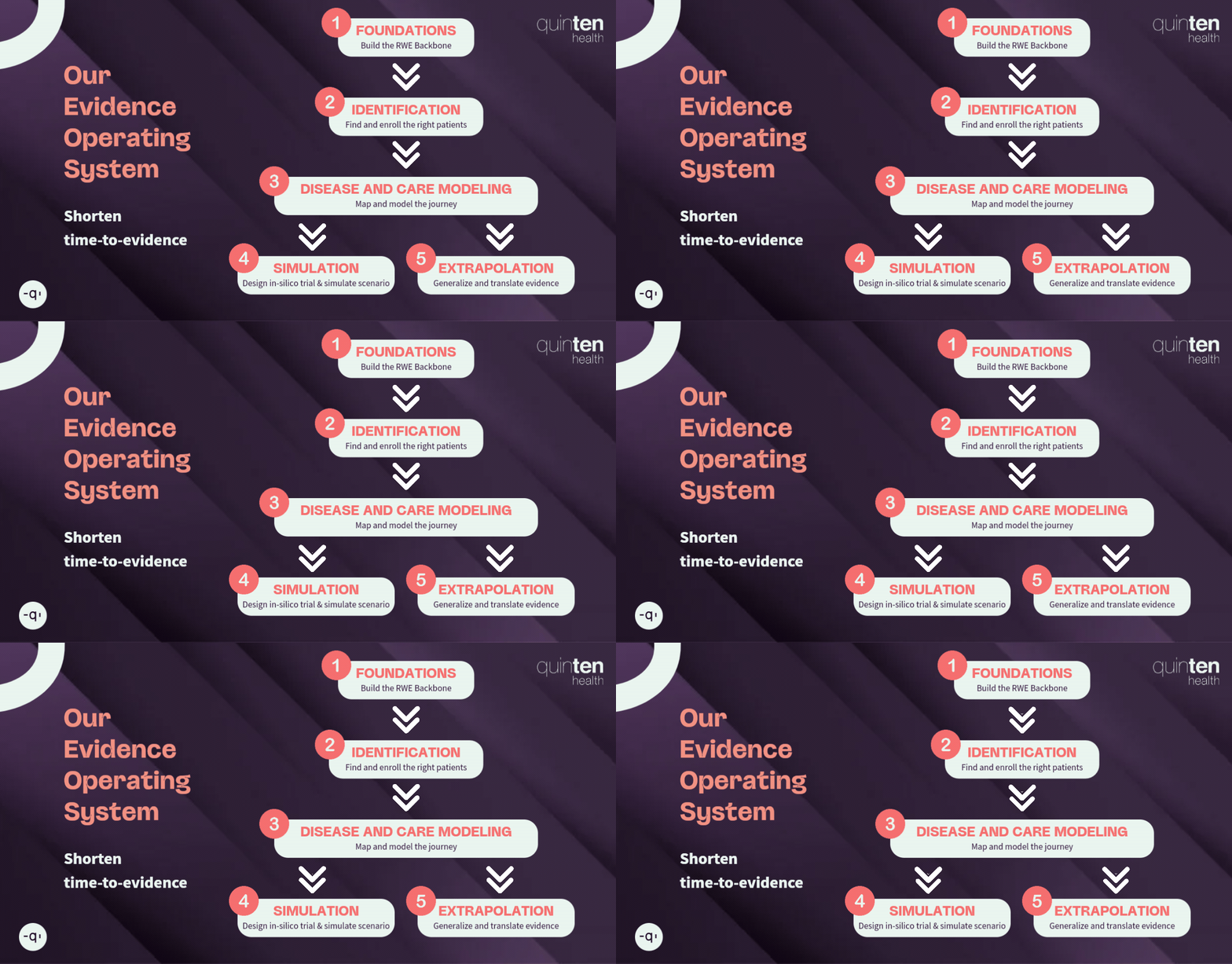
Organizations often run evidence work as isolated initiatives: a clinical trial here, a cohort study there, a literature review in parallel, each useful, but difficult to assemble into a single defensible story. A more comprehensive and efficient approach is to connect evidence work end-to-end: integrating multiple sources into one coherent workflow to reduce uncertainty and strengthen confidence in the outputs. This is the logic behind Quinten Health’s Evidence Operating System: a patient-centric framework that connects data readiness, cohort construction, modeling, simulation, and translation.
Our Evidence Operating System in 5 pillars
Our five-part structure that supports an end-to-end workflow from raw inputs to actionable evidence.
1 Foundations: Build the RWE backbone
Create the conditions for credible downstream work by:
- • Establishing data quality standards and checks
- • Ensuring data lineage and governance
- • Defining reproducible pipelines that support review and auditability
2 Identification: Find and enroll the right patients
Maximize the strategic value of clinical trials by identifying high-value patient populations and refining trial designs:
- • Phenotyping & pre-diagnostic finder/algorithms
- • Eligibility criteria optimization
- • Responder enrichment, identification of subgroup of good responders
- • Trial rescue & adaptive redesign
3 Disease & Care Modeling: Map and model the journey
Describe and model the patient journey to support clearer interpretation:
- • Disease diagnostic and evolution
- • Treatment trajectories
- • Prescription and adherence patterns
- • Heterogeneity in terms of patients’ characteristics, disease evolution and treatments
- • Drivers of risk, progression, treatment adherence, treatment response
4 Simulate: In-silico design and scenario simulation
Explore options when conventional designs are constrained:
- • Testing design choices and timing windows
- • Enriching small cohorts or under-represented subgroups
- • Exploring alternative comparators or endpoints
- • Exploring alternative scenarios (e.g. alternative treatment positioning) to inform development and evidence planning
5 Bridge & Extrapolate: Generalize and translate evidence
Connect findings across sources and populations:
- • Aligning trial and real-world populations
- • Extrapolating to broader or different populations (e.g. from adult to pediatric)
- • Translating results to decision contexts
- • Ensuring evidence is interpretable for regulatory and access needs
Across all five pillars, the emphasis is on clarity: making the evidence chain understandable, discussable, and ready for review.
Accelerating timelines without weakening trust
Acceleration comes from reducing rework and enabling faster iteration, while keeping the evidence chain transparent. At Quinten Health, this is supported by:
-
- Reusing standardized components (definitions, templates, reporting structures),
- Automating repetitive steps where appropriate,
- Reducing rework through strong foundations and traceability,
- Enabling faster iteration because the workflow is reviewable end-to-end.
This shifts effort away from repeatedly rebuilding the basics and toward producing evidence outputs that can be evaluated and acted upon.
Outcome: evidence that supports decisions
When evidence is built to be robust, transparent, and reviewable, it can meaningfully support:
-
- Development decisions in constrained settings
- Regulatory planning and evidence packages
- Access strategies and reimbursement submissions
- Alignment across clinical, regulatory, and market access stakeholders
Ultimately, the purpose is practical: helping innovation reach patients sooner, especially in contexts where traditional approaches face limits.
Contact us
If you are working in a setting with constrained trials, small populations, or high heterogeneity, we’re happy to discuss how to structure an evidence workflow that remains defensible end-to-end.
GET IN TOUCH