
When head-to-head evidence is unavailable, conventional Indirect Treatment Comparisons (ITCs) can estimate the relative effects of competing treatments through a shared comparator. A Bucher adjusted indirect comparison combines treatment effects from two trials, or more generally studies1. The network meta-analysis (NMA) extends this principle across larger networks of treatments and studies, combining direct and indirect comparisons2. These methods can be conducted using aggregate-level results and preserve the benefits of randomization when the evidence network is connected through randomized comparisons.
 However, conventional ITCs rely on sufficient comparability between the populations in included studies. In particular, the distribution of treatment-effect modifiers should not differ materially across compared populations, and the studies should satisfy the assumptions of similarity, homogeneity and transitivity. When populations differ in characteristics that modify the relative treatment effect, an aggregate-data ITC may estimate a biased or poorly transportable comparison. Likewise, a naïve comparison, i.e. looking at the unadjusted outcomes side-by-side, is highly problematic and can easily bias the treatment evaluation.
This bias occurs because the underlying patient populations across different studies are rarely identical. Patients may differ significantly in terms of baseline characteristics, prognostic factors, and treatment-effect modifiers. If these differences are ignored, it becomes impossible to determine whether the observed results are driven by the actual efficacy of the treatments or simply by the baseline disparities between the two patient groups.
However, conventional ITCs rely on sufficient comparability between the populations in included studies. In particular, the distribution of treatment-effect modifiers should not differ materially across compared populations, and the studies should satisfy the assumptions of similarity, homogeneity and transitivity. When populations differ in characteristics that modify the relative treatment effect, an aggregate-data ITC may estimate a biased or poorly transportable comparison. Likewise, a naïve comparison, i.e. looking at the unadjusted outcomes side-by-side, is highly problematic and can easily bias the treatment evaluation.
This bias occurs because the underlying patient populations across different studies are rarely identical. Patients may differ significantly in terms of baseline characteristics, prognostic factors, and treatment-effect modifiers. If these differences are ignored, it becomes impossible to determine whether the observed results are driven by the actual efficacy of the treatments or simply by the baseline disparities between the two patient groups.
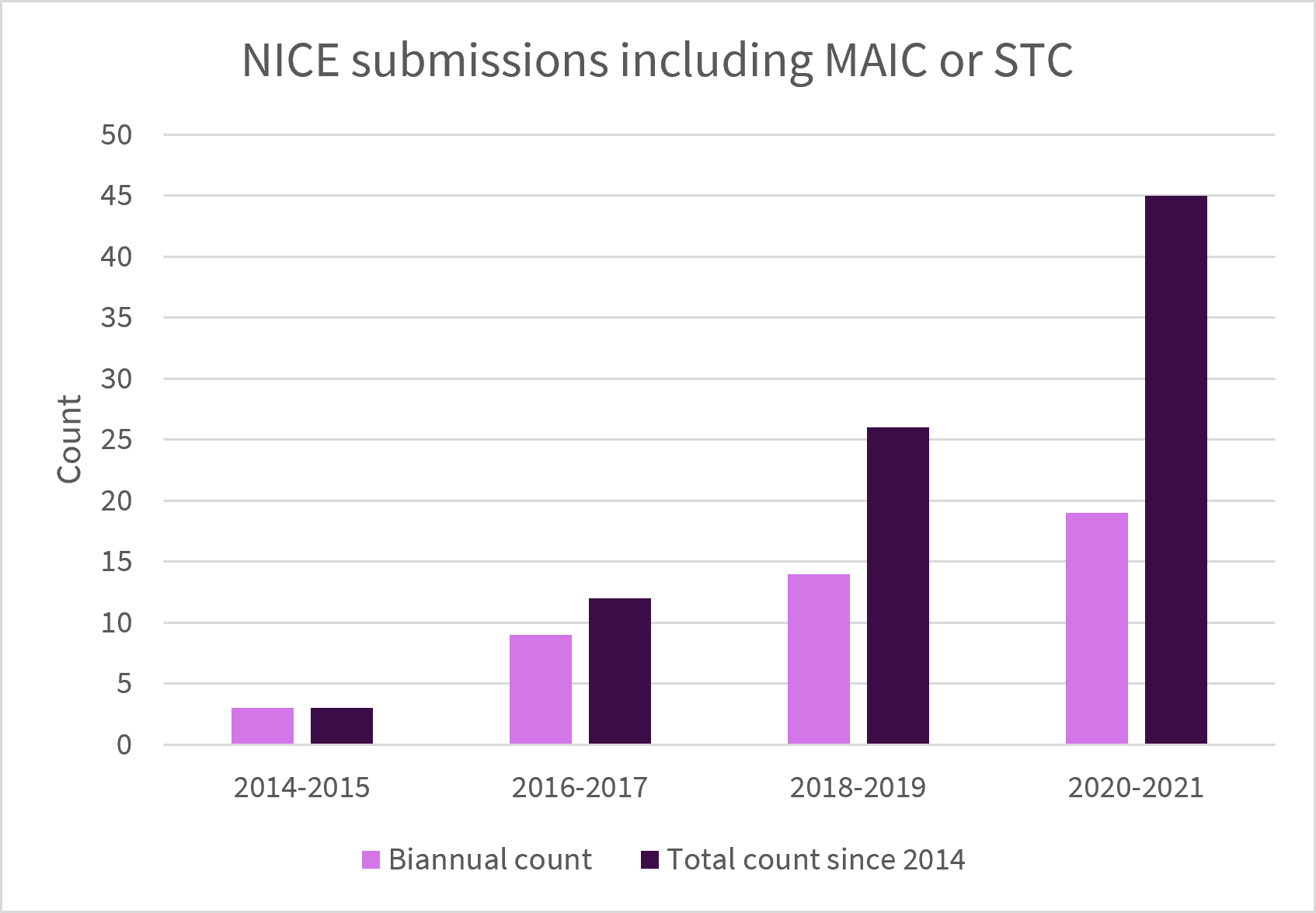
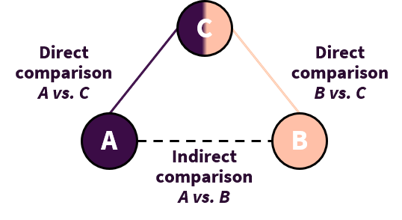
Illustration: Two direct comparisons, treatment A versus comparator C and treatment B versus comparator C, are used for an indirect comparison of treatment A versus treatment B.
The Challenge
A common situation for drug-developing companies is that they have patient-level data only for their treatment, and only aggregated data for the intended comparator, with no head-to-head comparison whatsoever. How to compare two treatments in this scenario? Consequently, the core challenge is implementing a robust statistical adjustment to create a fair comparison between study populations. To achieve a credible and reliable comparison, researchers must successfully align these distinct populations by ensuring rigorous covariate balance, verifying adequate population overlap, and maintaining a sufficient effective sample size. Furthermore, the challenge extends to properly quantifying uncertainty and running sensitivity analyses to assess the impact of any potential departures from the underlying statistical assumptions. This is precisely where population-adjusted indirect comparisons become relevant, providing methods to account for cross-trial population differences when direct comparative evidence is unavailable2,3.Methodological Landscape
Population-adjusted indirect comparisons (PAIC) consists of three key methods: Matching Adjusted Indirect Comparison (MAIC), Simulated Treatment Comparison (STC) and more recently Multilevel Network Meta-Regression (ML-NMR). While all three have similar assumptions, there is a difference in the requirements and resulting levels of bias3,4. Briefly:- MAIC reweights individual patient data to match a comparator trial’s covariate summaries. When a valid common comparator is available, anchored MAIC requires adjustment for treatment-effect modifiers. In single-arm settings without a common comparator, unanchored MAIC must also adjust for prognostic factors, relying on the substantially stronger assumption that all relevant effect modifiers and prognostic variables have been measured and appropriately accounted for. MAIC is limited to pairwise comparison.
- STC models outcomes using both prognostic factors and effect modifiers. STC may be preferred when a credible outcome model can be specified, particularly when MAIC would result in substantial weight instability or a low effective sample size; however, it is more dependent on model specification. STC is limited to pairwise comparison.
- ML-NMR combines individual and aggregate data across an evidence network while modelling treatment-effect modifiers. Unlike MAIC and STC, ML-NMR can compare multiple studies and treatments. It is most appropriate when a connected evidence network is available, patient-level data are available for at least some studies, and treatment effects are required for one or more clearly defined target populations.
Adjustment methods overview
| Type of method | Data availability scenario | |
|---|---|---|
| Patient-level data vs. patient-level data | Patient-level data vs. aggregated data | |
| Propensity-score based method | Inverse-probability weighting (IPW) | Matching-adjusted indirect comparison (MAIC) |
| Outcome-regression based method | Regression adjustment | Simulated treatment comparison (STC) |
| Propensity-score based and outcome-regression based methods | Doubly robust | Doubly robust |
Table 1. Adapted from Park et al. (2024)5.
To be reliable, an indirect comparison should report not only the treatment effect, but also diagnostic information (e.g. population overlap, covariate balance, effective sample size), uncertainty quantification (e.g. quantitative bias analysis), sensitivity analyses to assess the impact of potential departures from statistical assumptions, and the rationale for each modelling decision.Methodological choices should not aim to answer the question “which method is the most advanced?”, but rather “which method fits best the decision, the evidence network, the available covariates, and the regulatory/HTA expectations?”.
Typical Use Cases & Applications
Typical applications of PAIC include:- Comparing efficacy across non-head-to-head Phase III randomized controlled trials (RCTs)6,7.
- Comparing a single-arm trial against an external comparator5,8.
- Estimating Real-World effectiveness by projecting RCT treatment effects to Real-World populations9.
Regulatory Viewpoint: a fragmented HTA landscape
While the use of Population-Adjusted Indirect Comparisons (PAIC) in regulatory and Health Technology Assessment (HTA) submissions is continuously increasing, securing approval is far from guaranteed. Life-science organizations face a highly complex landscape where acceptance criteria and methodological expectations vary significantly between countries. A recent study evaluating HTA agencies’ acceptance of ITC methods in oncology (between 2018 and 2021) starkly highlights this European disparity11. This striking contrast underscores a critical reality: HTA bodies remain cautious about potential methodological biases and the quality of external data. To successfully bridge the gap between Real-World Data (RWD) and regulatory-grade evidence, sponsors cannot rely on a “black box” approach. They should follow available guidelines12,13, provide exhaustive diagnostic information, rigorous sensitivity analyses, and clear rationales for every modelling decision.
NICE: National Institute for Health and Care Excellence, the HTA body in England
Understanding Population-Adjusted Indirect Comparisons
Discover how advanced population-adjustment methodologies can successfully bridge the gap to regulatory-grade evidence.
Quinten Health’s Expertise
We leverage long-term expertise in advanced analytics and predictive modelling on both clinical trial data (RCT and SAT) and real-world data to bridge the gap between data and regulatory-grade evidence. By developing robust and advanced statistical pipelines, we accompany our clients in producing transparent and reproducible ITC analyses to support regulatory and HTA negotiation strategies.Connect with our experts at Quinten Health to learn more about PAIC.
References
- Bucher HC, Guyatt GH, Griffith LE, Walter SD. The results of direct and indirect treatment comparisons in meta-analysis of randomized controlled trials. Journal of Clinical Epidemiology. 1997;50(6):683–691.
- Dias S, Welton NJ, Sutton AJ, Caldwell DM, Lu G, Ades AE. NICE DSU Technical Support Document 4: Inconsistency in Networks of Evidence Based on Randomised Controlled Trials. 2011.
- Phillippo, D.M., Dias, S., Ades, A.E. and Welton, N.J., 2020. Assessing the performance of population adjustment methods for anchored indirect comparisons: a simulation study. Statistics in medicine, 39(30), pp.4885-4911.
- Remiro‐Azócar, A., Heath, A. and Baio, G., 2021. Methods for population adjustment with limited access to individual patient data: a review and simulation study. Research synthesis methods, 12(6), pp.750-775.
- Park, J. E., Campbell, H., Towle, K., Yuan, Y., Jansen, J. P., Phillippo, D., & Cope, S. (2024). Unanchored population-adjusted indirect comparison methods for time-to-event outcomes using inverse odds weighting, regression adjustment, and doubly robust methods with either individual patient or aggregate data. Value in Health, 27(3), 278-286.
- Signorovitch, J. E., Wu, E. Q., Yu, A. P., Gerrits, C. M., Kantor, E., Bao, Y., … & Mulani, P. M. (2010). Comparative effectiveness without head-to-head trials: a method for matching-adjusted indirect comparisons applied to psoriasis treatment with adalimumab or etanercept. Pharmacoeconomics, 28(10), 935-945.
- Phillippo, D. M., Dias, S., Ades, A. E., Belger, M., Brnabic, A., Schacht, A., … & Welton, N. J. (2020). Multilevel network meta-regression for population-adjusted treatment comparisons. Journal of the Royal Statistical Society Series A: Statistics in Society, 183(3), 1189-1210.
- Van Sanden, S., Ito, T., Diels, J., Vogel, M., Belch, A., & Oriol, A. (2018). Comparative efficacy of daratumumab monotherapy and pomalidomide plus low‐dose dexamethasone in the treatment of multiple myeloma: a matching adjusted indirect comparison. The oncologist, 23(3), 279-287.
- Paget, M. A., Tockhorn-Heidenreich, A., Belger, M., Chartier, F., & Lantéri-Minet, M. (2023). Generalizability of clinical trial efficacy results to a real-world population: An example in migraine prevention. Journal of Managed Care & Specialty Pharmacy, 29(12), 1321-1330.
- Camm, A. J., Amarenco, P., Haas, S., Hess, S., Kirchhof, P., Lambelet, M., … & Turpie, A. G. (2019). Real-world vs. randomized trial outcomes in similar populations of rivaroxaban-treated patients with non-valvular atrial fibrillation in ROCKET AF and XANTUS. EP Europace, 21(3), 421-427.
- Macabeo, B., Rotrou, T., Millier, A., François, C., & Laramée, P. (2024). The Acceptance of Indirect Treatment Comparison Methods in Oncology by Health Technology Assessment Agencies in England, France, Germany, Italy, and Spain. PharmacoEconomics – Open, 8(1), 518. https://doi.org/10.1007/s41669-023-00455-6
- Phillippo, D., Ades, T., Dias, S., Palmer, S., Abrams, K. R., & Welton, N. (2016). NICE DSU technical support document 18: methods for population-adjusted indirect comparisons in submissions to NICE.
- Jansen, J. P., Fleurence, R., Devine, B., Itzler, R., Barrett, A., Hawkins, N., … & Cappelleri, J. C. (2011). Interpreting indirect treatment comparisons and network meta-analysis for health-care decision making: report of the ISPOR Task Force on Indirect Treatment Comparisons Good Research Practices: part 1. Value in health, 14(4), 417-428.