
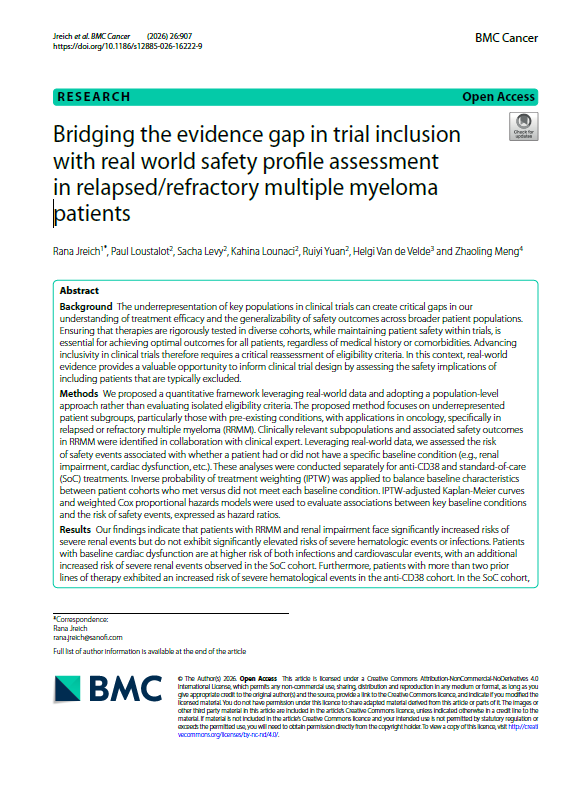
Bridging the evidence gap: How Real-World Data can make cancer clinical trials more inclusive
Clinical trials are the gold standard for testing new medical treatments. However, the patients who enroll in these trials don’t always represent the diverse real-world population that will eventually be treated by the drugs. Eligibility criteria frequently exclude individuals with pre-existing conditions, elderly patients, or those with complex medical histories for safety reasons.
To address this challenge, Quinten Health published a new study in BMC Cancer demonstrating how Real-World Evidence (RWE) can help identify opportunities to safely relax clinical trial eligibility criteria, with a specific focus on relapsed/refractory multiple myeloma (RRMM).
The inclusivity dilemma in oncology trials
While exclusion criteria aim to protect patient safety, they may create evidence gaps once a therapy is approved. In multiple myeloma, up to 80% of clinical trials exclude patients based on factors like performance status, kidney or liver dysfunction, or prior malignancies. This leaves healthcare providers with limited evidence on how new treatments affect broader, potentially more vulnerable patient groups in routine clinical practice.
Regulatory agencies, such as the US FDA, are now pushing for Diversity Action Plans to increase enrollment from underrepresented populations. But how can researchers expand inclusion criteria without risking patient safety or compromising trial integrity?
A data-driven framework to evaluate safety risks
Instead of assessing eligibility criteria in isolation, the study introduces a quantitative workflow leveraging Electronic Health Records (EHR) from the nationwide Flatiron Health database (comprising over 2,500 RRMM patients treated between 2017 and 2024).
The research team collaborated with clinical experts to evaluate safety risks in key underrepresented subpopulations, comparing patients with and without specific baseline conditions:
- Renal impairment
- Cardiac dysfunction
- High number of prior therapies
- History of prior malignancy
To ensure fair comparisons, the team used advanced statistical modeling, specifically Inverse Probability of Treatment Weighting (IPTW), to balance confounding baseline characteristics between patient groups. This study focused independently on patients treated with anti-CD38 and other standard-of-care (SoC) regimens.
Key findings: what does Real-World Data tell us?
The results provide valuable, actionable insights into how specific baseline conditions impact patient safety:
- Renal impairment: Patients with baseline kidney dysfunction did not show a significantly higher risk of severe hematologic events or infections compared with patients without renal impairment. However, as might be expected, they faced a significantly higher risk of severe renal complications during treatment.
- Cardiac dysfunction: Patients with pre-existing cardiac conditions experienced an increased risk of cardiovascular events and infections across both treatment cohorts.
- Prior lines of therapy: Patients who had received more than two prior lines of therapies showed an elevated risk of severe hematological events in the anti-CD38 cohort.
“Characterizing safety outcomes in populations often underrepresented in clinical trials offers contextual evidence to support more inclusive trial designs, while acknowledging the inherent limitations of observational data.”
Building safer, more inclusive clinical trials
Aiming at expanding diversity in trials, this study advocates for a cautious, evidence-based strategy. Real-world data allows researchers to identify which risks are manageable through targeted monitoring, paving the way for pragmatic trial designs that reflect real-world clinical practice.
📄 Read the full open-access publication in BMC Cancer:
Jreich, R., Loustalot, P., Levy, S., Lounaci, K., Yuan, R., Van de Velde, H., & Meng, Z. (2026). Bridging the evidence gap in trial inclusion with real world safety profile assessment in relapsed/refractory multiple myeloma patients. BMC Cancer, 26, 907. https://doi.org/10.1186/s12885-026-16222-9