

At ISPOR Europe 2025, Quinten Health introduced an AI-powered tool, a deliverable of the More-EUROPA consortium, designed to make real-world data discovery faster, smarter, and more transparent, supporting regulators, HTA bodies, and researchers to identify, assess, and select fit-for-use registries for evidence generation across the drug and product development lifecycles.
Leveraging AI to Identify and Assess Fit-for-Use Real-World Data Sources
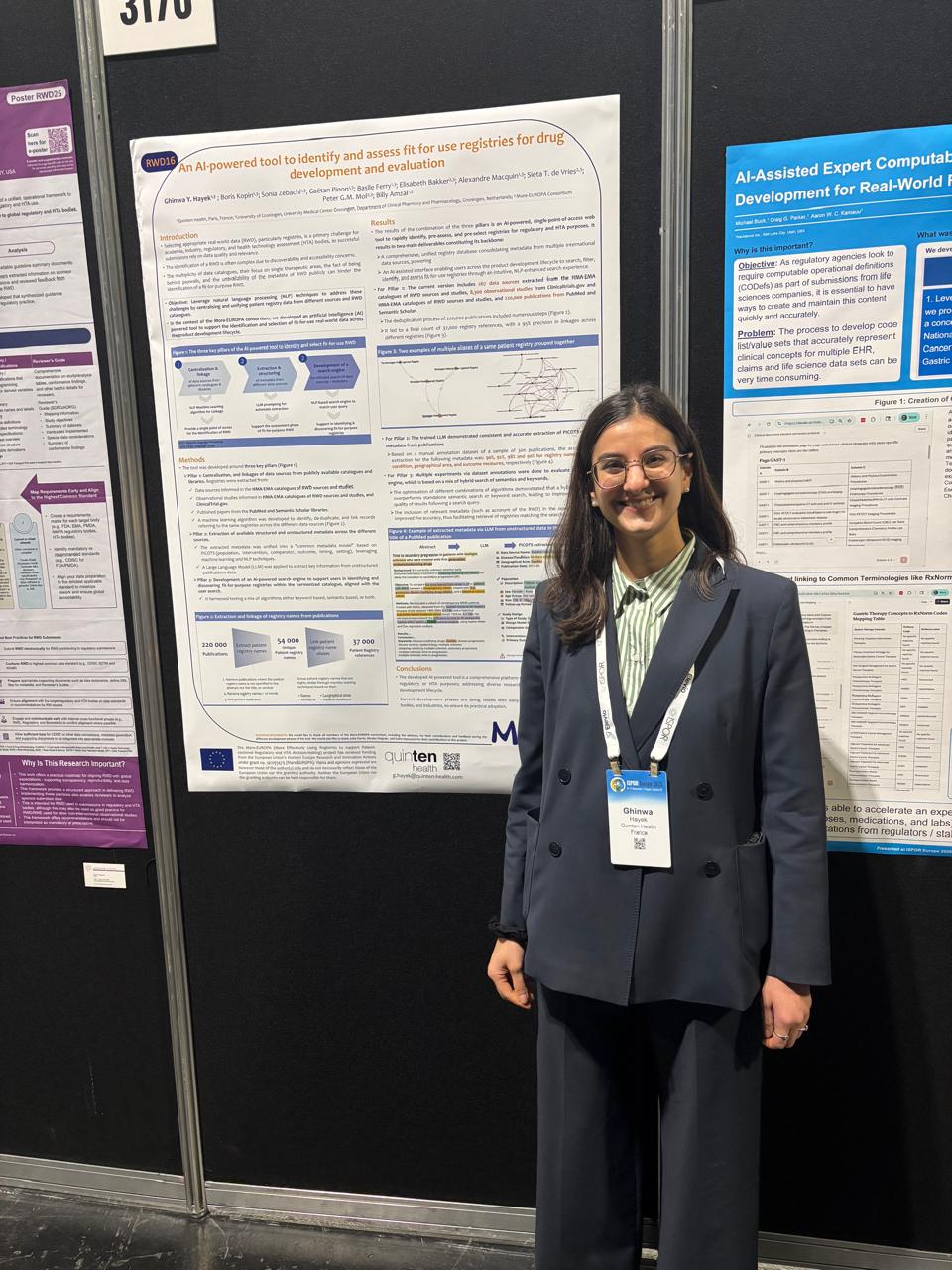
Identifying and evaluating real-world data (RWD) sources suitable for regulatory or HTA purposes remains a major challenge for healthcare decision-makers. The multiplicity of data catalogues, and the unavailability of the metadata publicly, can hinder the identification and assessment of fit-for-purpose RWD.
At ISPOR Europe 2025, Quinten Health presented a novel AI-powered tool designed to address this challenge, developed within the More-EUROPA consortium.
Turning Data Chaos into Clarity
The tool uses artificial intelligence to centralize and harmonize existing RWD sources from catalogues, and scientific publications.
By combining natural language processing (NLP) techniques, such as LLMs and machine learning, it extracts PICOTS metadata (such as disease condition, medical product, comparator, population characteristics, geographical location, and outcomes) to helps users rapidly identify registries adequate to their needs, via an AI-powered search engine built with keywords and semantic based algorithms.
The result?
A single-point of access web interface, including thousands of RWD and their standardized metadata to support fit-for-purpose evidence generation across the drug and product development lifecycles.
A Step Toward Trustworthy Real-World Evidence
This innovation represents an important milestone toward more transparent, reproducible, and regulatory/HTA-grade use of real-world data.
It supports faster, and smarter evidence generation to inform better healthcare decisions, across the lifecycle of medicines and products, from development to evaluation.
This project is part of the More-EUROPA initiative, funded by the European Union’s Horizon Europe programme.